
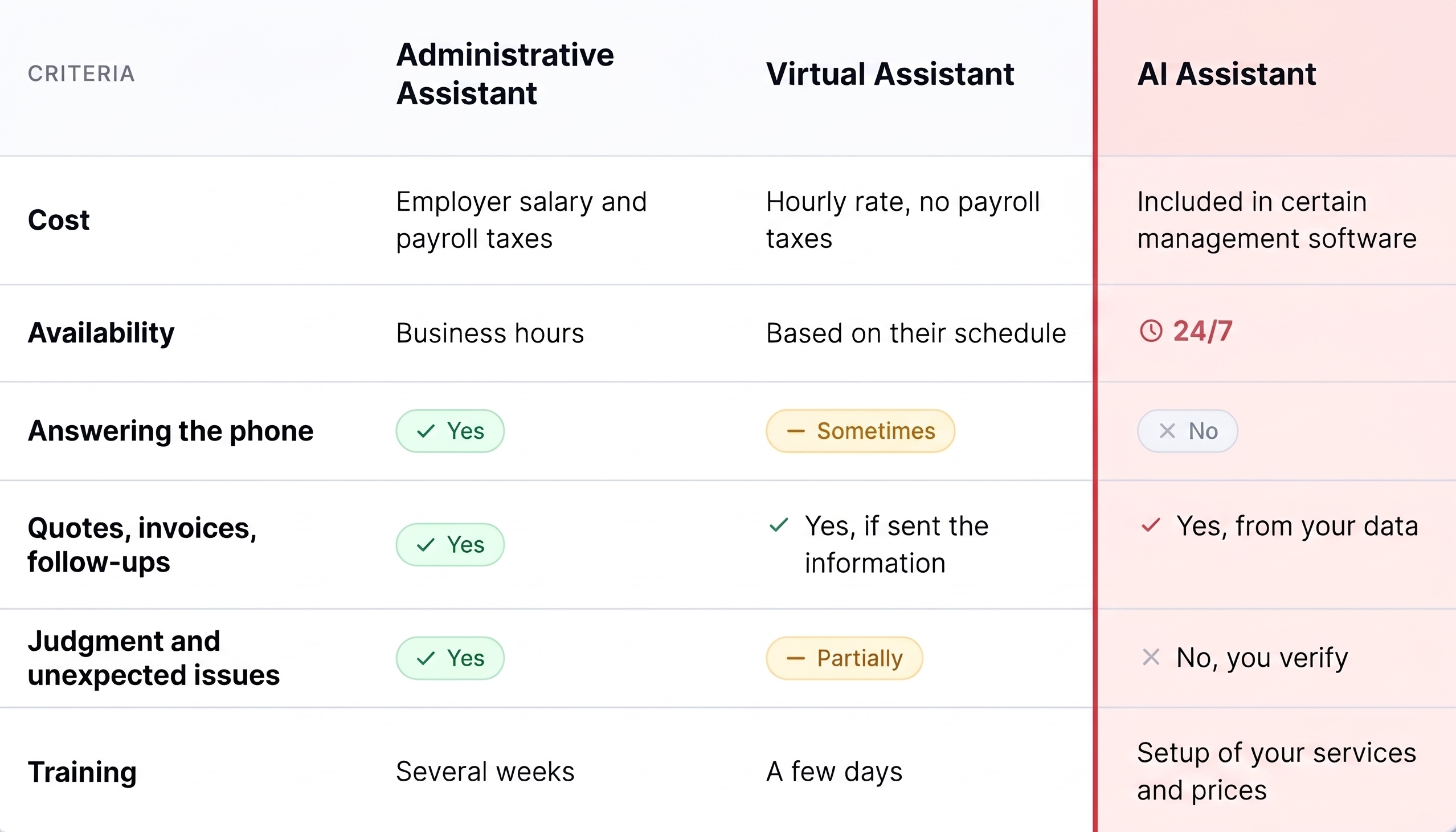
To free yourself from paperwork, you have three options: hire an administrative assistant, work with a virtual assistant or use an AI assistant. The first costs a salary and payroll contributions, the second is paid by the hour, and the third is often included in your management software.
The right choice depends on the size of your business and the tasks that take up the most of your time. Here is what each option does well, where it falls short and how to choose.
First: what is taking up your time?
Before choosing, make a list of what gets done in the office in a typical week. Among the contractors we meet in demos, we almost always find the same tasks:
answering the phone and taking messages;
entering new clients and putting together quotes;
following up on quotes that haven't been answered;
scheduling jobs and confirming appointments;
invoicing and following up on overdue accounts;
entering receipts and expenses;
compiling timesheets for payroll.
Some tasks call for judgment and a human voice. Others are repetitive: you retype the same information from one place to another. That difference is what will guide your choice.
Option 1: hire an administrative assistant
It is often the first move when a business grows. One contractor told us he hired an assistant when he reached about five employees: he needed to spend more time on job sites with his crew and was running out of time for paperwork.
What they do well: talk to customers with a real voice, handle the unexpected, get to know your business, work with your accountant. A good assistant makes decisions and takes things off your mind.
The downside: it is a fixed salary, even during slow weeks or the off-season. You have to find them, train them, and plan for vacations and time off. Many contractors also have a spouse or family member in the office, often part-time and in the evenings.
What it costs: according to the Bureau of Labor Statistics, the median pay for secretaries and administrative assistants was $48,310 a year, or $23.23 an hour, in May 2025. Even part-time, 20 hours a week at that rate comes to about $24,000 a year, before payroll taxes, workers' comp and any benefits.
Option 2: work with a virtual assistant
A virtual assistant is a self-employed worker who handles your administrative tasks remotely, often for several clients.
What she does well: you only pay for the hours worked, with no employer contributions. It's a good option for specific, regular tasks, like invoicing or document upkeep.
Where she falls short: she isn't on site and doesn't know your job sites. You have to send her the information: site visit notes, quantities, receipts. If that information stays in your head or on a scrap of paper in the truck, you still end up doing part of the work in the evening.
Option 3: use an AI assistant
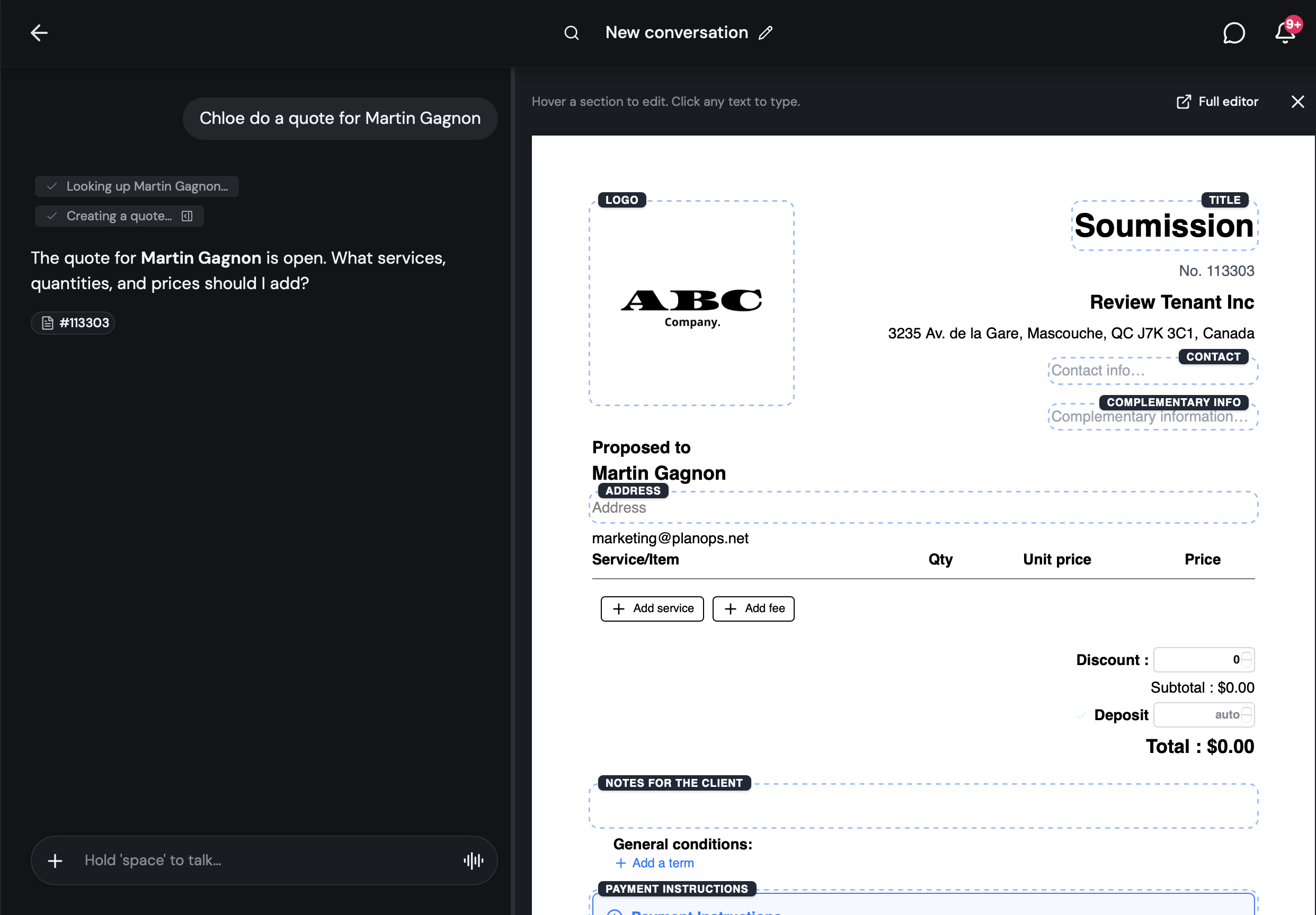
An AI assistant built into your management software works with your own data: your clients, your prices, your quotes and your calendar. You talk to it in writing or out loud, and it does the task.
What it does well: repetitive tasks, at any hour. Drafting a quote while you walk around the client's house, adding a receipt from a photo, converting a quote into an invoice, following up with a client. It doesn't take vacations and its cost doesn't change as the business grows.
Where it falls short: it doesn't replace a person for everything. It won't answer the phone for you, it won't resolve a client complaint and it won't do your bookkeeping. Its quotes are drafts that you review before sending them.
That's exactly what one contractor was looking for when his assistant went on maternity leave:
"I didn't necessarily want to hire an assistant. Answering the phone and emails, I can handle that, but all the rest of the tasks, I would have liked to replace with software."
Quick comparison
Which option should you choose?
You're on your own or have a small team. The problem is your evening time, not the volume. An AI assistant takes away a good part of the data entry and follow-ups, without adding a salary.
A contractor who puts together his own quotes and invoices told us this in a demo:
"I really like my evenings off, and my weekends. No need to do paperwork."
Your business is growing and the calls never stop. An assistant becomes useful for the human contact: answering, reassuring, coordinating. With an AI assistant handling data entry, she can manage more volume without you having to hire a second person right away.
You already have an assistant. The goal isn't to replace her, but to save her time. A contractor whose mother works in the office told us that having someone in the office is "not a bad thing," but he wanted to save her time. When your crews punch in on their phones and quotes arrive already put together, she spends less time retyping and more time with clients.
Before you hire: 4 questions to ask yourself
How many hours a week do you really spend on office work? Track them for two weeks. One contractor told us that he and his spouse spent about 25 hours a week on it, in the evenings, doing payroll and quotes.
Which tasks need a human voice? The phone, complaints, negotiation. The rest can often be automated.
Are your tools ready? An assistant who retypes paper timesheets and quote notes wastes a good part of her time. Centralizing your clients, your prices and your job sites in a single piece of software helps her as much as it helps you.
What do you want to do with the time you get back? More job sites, more quotes sent the same day, or simply your evenings.
Chloe, PlanOps's AI assistant
In PlanOps, Chloe has access to your clients, your services and prices, your quotes and your calendar. You talk to her in French, in writing or out loud, from your cell phone or computer.
She can also put together a quote that you dictate on site, add an expense from a photo of a receipt, schedule a job, convert a quote into an invoice, follow up on quotes and unpaid invoices by text message and remind your clients of their appointments. Invoices sync with QuickBooks, where your bookkeeping is done. For text messages, you need to add a phone line to Chloe, an option that is added to your plan.
For other ways to use AI in your business, read our article How to Use AI in Your Construction Business.
A day with Chloe
8 a.m. A client calls you while you're on a job site. As soon as you hang up:
"Chloe, add a new lead: Bryan Smith, 450 555-1234, he wants to redo his asphalt driveway. Send me a notification at 5 p.m. so I don't forget his quote."
1 p.m. You're at another client's. You walk around the house dictating the quote: the service, the quantities, the price if it differs from your list. You review it and send it before leaving.
3 p.m. Stop at the hardware store. You take a photo of the receipt and Chloe adds it to the expenses of the right project, so you know what the job really cost you.
5 p.m. Mrs. Tremblay's job is finished: "Chloe, convert the quote into an invoice and send it." Your reminder for Marc Gagnon's quote arrives at the same time.
Two days later. The 1 p.m. client hasn't answered. Chloe sends him a text message to ask if he has any questions.
Result: nothing to catch up on in the evening.
Chloe and your office assistant
If you already have someone in the office, Chloé doesn't replace them: she takes data entry off their plate. Your assistant keeps what needs a person: the phone, customers, surprises and working with your accountant. Estimates arrive already drafted, hours are already clocked and receipts are already on the right job. They spend less time retyping and more time with your customers.
For text follow-ups and reminders, Chloé needs her own phone line, an add-on to your plan.
During onboarding, our team sets up your account with your services and prices, so Chloé is useful from day one.
Frequently asked questions
How much does an administrative assistant cost a contractor?
It depends on your area, experience and hours. The BLS puts the national median at $23.23 an hour (May 2025). At 20 hours a week, that is about $24,000 a year, before payroll taxes, workers' comp and benefits.
When should I hire an office assistant?
When office work keeps you off job sites or away from selling, or when calls and customers need a person available during the day. Start by tracking your office hours for two weeks.
Can an AI assistant replace an administrative assistant?
For repetitive tasks, largely: data entry, estimates, invoices, follow-ups and reminders. For the phone, surprises and customer relationships, a person is still better. Many businesses use both.
What is the difference between a virtual assistant and an AI assistant?
A virtual assistant is a person who works remotely and bills by the hour. An AI assistant is a tool built into your software, available anytime, that works from your own data but doesn't replace human judgment.
Can my assistant use Chloé?
Yes. Your assistant can have their own PlanOps login and ask Chloé to handle data entry, so they can focus on the work that takes judgment.